PROTAC ternary complexes
A PROTAC's activity depends on a three-body equilibrium.
Follow ternary complex formation, stability, and dissociation in one trace.
ternary kinetics

Every degrader program raises its own binding question. The inQuiQ answers them from one platform.
A PROTAC's activity depends on a three-body equilibrium.
Follow ternary complex formation, stability, and dissociation in one trace.
Similar potency does not reveal complex stability.
Rank each molecular glue degrader by stability and off-rate, not a single timepoint.
VHL, CRBN, and other ligase recruiters need direct confirmation.
Measure recruiter engagement directly as a real KD.
Separate arm affinities do not reveal cooperativity.
Measure both arms under the same conditions to derive cooperativity.
A LYTAC brings a surface or secreted protein to a lysosomal receptor.
Measure both binding arms and the ternary complex on the same chip.
PROTACs, molecular glues, or LYTACs: discuss your assay with one of our application specialists.

Four independently addressable flow channels, each carrying four sensors, with the sample flowing through the channels in series.
Binary and ternary binding are followed in the same run, so two degraders that plateau at the same response are still separated on off-rate.
The degrader, the target, and the E3 ligase all meet unmodified, so nothing added to any of the three shifts the equilibrium being measured.
Inject the degrader alone, then pre-formed with its partner. A more stable ternary complex signals positive cooperativity; a weaker one signals a clash.
Label-free analysis for targeted protein degradation follows one sequence, whether measuring a single arm of a targeted protein degrader or a formed complex. The target or E3 ligase is immobilized, sample flows past, and binding is recorded in real time. An endpoint assay shows a complex existed; the inQuiQ shows how long it lasted.
Channel 1 degrader alone
Channel 2 pre-formed pair
The target protein is attached to both channels.
Amine coupling or capture through a tag holds the protein in place. Either partner works: the target for degrader engagement, the E3 ligase for recruiter engagement. Both channels carry the same surface, so whatever differs later is the sample, not the chemistry.
Unused activated sites are capped before the first compound arrives.
Without it the surface keeps reacting with whatever passes over, and non-specific binding shows up as signal unrelated to the pair being measured. The response then settles at the immobilized amount.
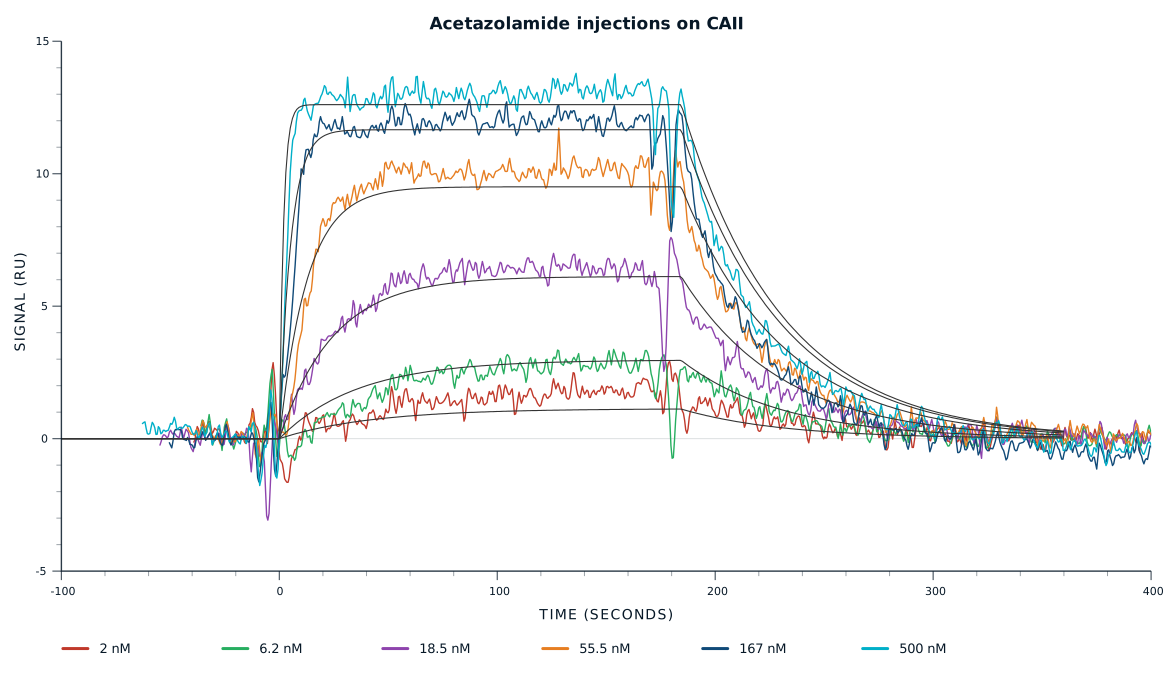
The degrader flows alone across the first channel and the response climbs.
The binary arm is injected alone to measure engagement with the immobilized partner. A reference channel subtracts what the surface contributes by itself. Flow rate sets contact time, and the association phase gives an on-rate, ka.
The pre-formed pair runs on the second channel and climbs much further.
Injection stays below saturation to avoid the hook effect. The recruited partner carries far more mass than the degrader alone, so the ternary response sits well above the binary trace on the same surface.
Buffer replaces the sample and both responses fall, at different rates.
The dissociation phase gives the off-rate, kd, and 1/kd gives the ternary complex's residence time. Comparing the two channels gives cooperativity directly: α = KD,binary / KD,ternary. Single-cycle kinetics runs a concentration series uninterrupted when early material is scarce.
Regeneration buffer returns both channels to baseline for the next injection.
The immobilized target stays in place, so every degrader meets the same surface. Candidates run in series, unattended, and each injection is read by every sensor on the chip, covering several targets, E3 ligases, or counter-screen controls.
Six capabilities, one modular benchtop instrument, label-free.
Four flexibly addressable channels for improved assay freedom, with 16 sensors to screen E3 ligases, targets, and controls efficiently.
Baseline noise stays low enough that a binary arm's small mass change is still readable.
One affinity range spans early degrader hits and optimized leads, with steady-state fitting where kinetics run out.
Competitive assays show whether a ternary complex is more stable than its binary arms, and cooperativity is derived directly.
The temperature-controlled flow cell runs a full temperature series on the same complex.
Add an autosampler and scale up your throughput for larger degrader or glue libraries.
Capture the E3 ligase or the target on the sensor, inject the PROTAC, or proteolysis targeting chimera, pre-incubated with its binding partner, then follow the dissociation phase. The off-rate (koff) gives the dissociative half-life of the ternary complex. The inQuiQ records this in real time, so a PROTAC drug candidate is ranked on measured complex lifetime rather than on an endpoint.
Cooperativity (α) compares binary and ternary affinity: α = KD,binary / KD,ternary. Above 1, the third partner stabilises the complex and the degrader binds more tightly in the ternary state. Below 1, it interferes. The inQuiQ measures both arms under the same conditions, so PROTAC cooperativity comes from one dataset rather than from two experiments run apart.
At high PROTAC concentrations, binary complexes with the target and with the ligase outcompete the ternary complex, so signal falls as concentration rises. Avoid the hook effect by titrating the PROTAC across a wide range and keeping the ternary injection below saturation. A 10 pM to 10 mM range covers both sides of the curve.
Yes. Samples run directly after a 0.22 µm filter. The antifouling hydrogel surface keeps non-specific binding low in complex material, which matters for early candidates that are not available as purified protein.
The minimum is 30 µL per sample, and up to 2 mL can be injected when a low-concentration analyte needs longer contact time. Early degrader campaigns usually have limited protein, so a small injection volume with a reusable chip keeps a full concentration series within reach.
The measurement is the same three-body problem. A LYTAC links an extracellular or membrane target to a lysosomal receptor instead of an E3 ligase, so the two binary arms and the ternary complex are measured exactly as they are for a PROTAC: immobilise one partner, inject the other alone and then pre-formed, and compare the off-rates.