Fragments and covalent fragment screening
Detect binding of fragments under 300 Da.
Confirm that a fragment binds at all.
weak binders

Every compound class brings its own binding question. inQuiQ answers them from one platform.
Detect binding of fragments under 300 Da.
Confirm that a fragment binds at all.
Separate potency from residence time.
Two inhibitors with the same IC50 can have very different off-rates.
Measure dose-response directly on the target.
Binding and inhibition measured on the same surface, in the same run.
Find out where on the target a compound acts.
Competitive assays reveal where a compound binds.
Measure peptide-protein kinetics across chemistries.
Test with assay-relevant solvents, salts, and additives.
Discuss your assay with one of our application specialists.

Four independently addressable flow channels, each carrying four sensors, with the sample flowing through the channels in series.
Low baseline noise resolves small mass changes, while flow rate controls target contact time. Affinity spans 10 pM to 10 mM, with steady-state fitting for fast dissociation.
The target meets the ligand without labels that could alter small-molecule binding.
Inject the compound against a known site binder. Competition reveals whether both compounds share the same binding site.
Every measurement follows the same steps, no matter the compound. The target is captured on the sensor, the compound flows past, and the instrument records the binding response in real time. An endpoint assay gives you one number. The inQuiQ gives you the full curve.
The target protein is attached to the sensor surface first.
Amine coupling or capture through a tag holds it in place. This target-on-the-surface setup suits fragment-based drug discovery, fragment library screening and a peptide binding assay, with the compound injected as the analyte.
Unused activated sites are capped before the first compound arrives.
Without it the surface keeps reacting with whatever passes over, and non-specific binding shows up in the trace as signal unrelated to the pair being measured. The response then settles at the immobilized amount.
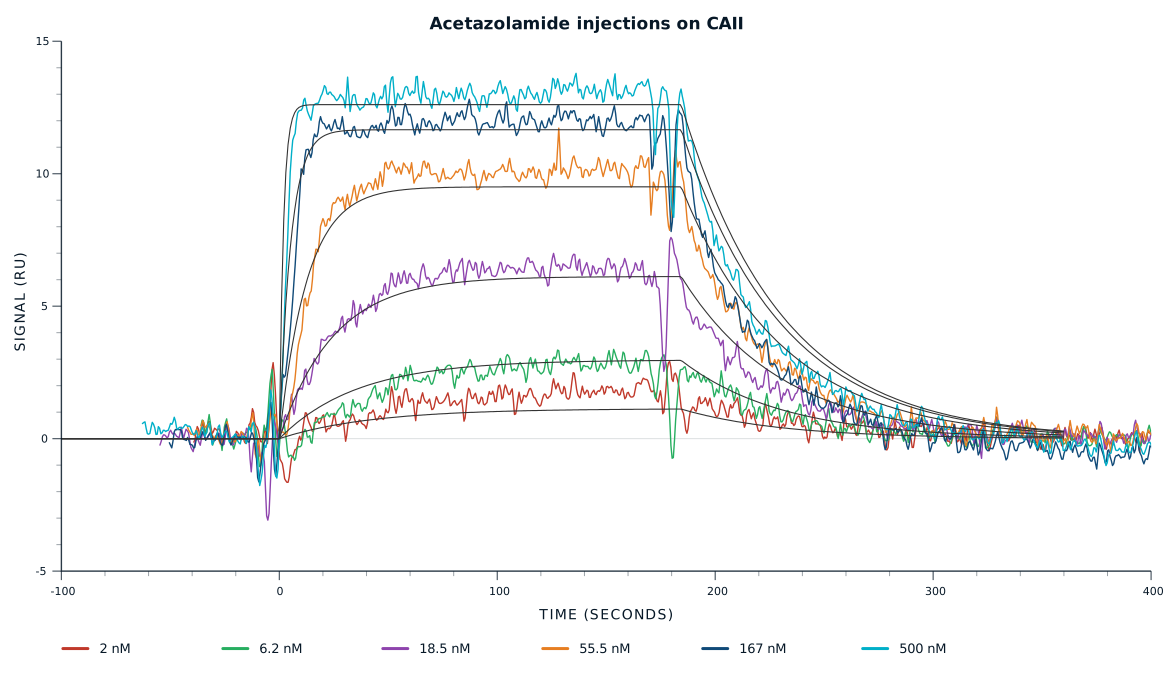
The compound flows across the surface and the response climbs.
Sample and running buffer are matched so the bulk signal does not swamp the binding, and a reference channel removes what remains. Flow rate sets contact time, and the rising phase gives the on-rate, ka.
Buffer replaces the sample and the response falls as the complex comes apart.
The falling phase gives the off-rate, kd, and 1/kd is residence time. A concentration series yields ka, kd, and KD. Where dissociation is too fast to fit, injection plateaus give steady-state affinity. With little material, single-cycle kinetics runs the series uninterrupted.
A regeneration buffer strips bound compound and returns the sensor to baseline.
The immobilized target stays in place, so every compound meets the same surface. Inject, read, regenerate, repeat, unattended. Every sensor on the chip reads each injection, so one sample can cover several targets, mutants, or controls.
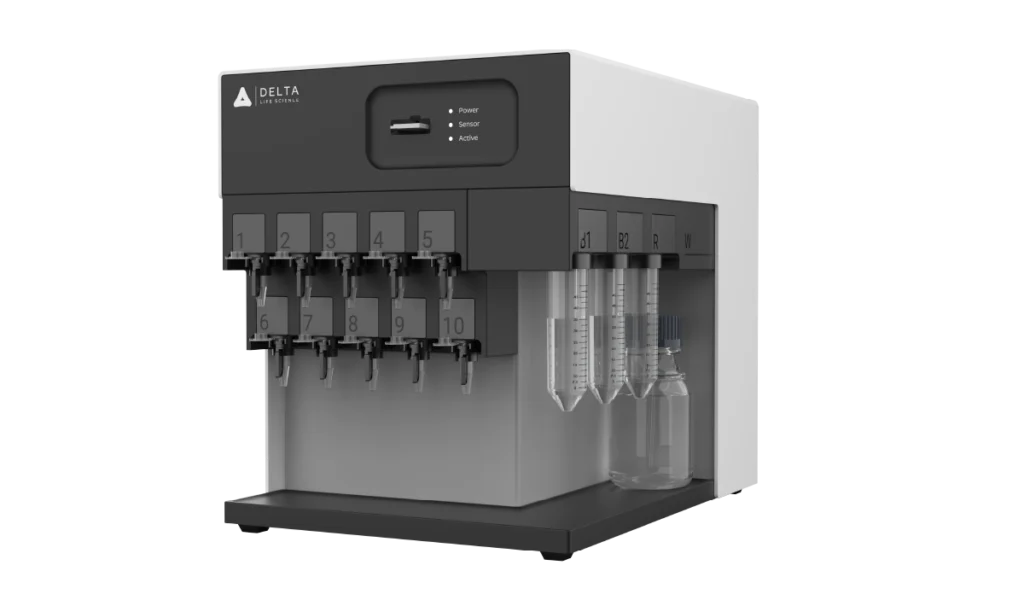
Six capabilities, one modular benchtop instrument, in a label-free workflow.
Flexibly addressable channels for improved assay freedom, with 16 sensors to screen mutants, off-targets and controls efficiently.
Baseline noise stays low enough that a fragment-sized mass change is still readable.
Measure mM fragment binding and pM lead binding for fragment-based lead discovery. Fast binding yields KD by steady-state analysis.
Competitive assays show whether compounds share a site, while dose response supports IC50 determination.
The temperature-controlled flow cell runs a full temperature series.
Simply add an autosampler, and increase your throughput for library screens.
A small molecule binding assay starts by immobilizing the target protein on the sensor, then injecting a concentration series of the compound. The inQuiQ records association and dissociation in real time and fits the data to give affinity (KD) and kinetics (kon, koff) across a range of 10 pM to 10 mM. Weak binders are fitted at steady state instead.
Yes, as long as the sensor resolves the small mass change a fragment produces. The inQuiQ runs at a baseline noise of 0.1 RU RMS, and ligand density is set high enough that a fragment under 300 Da gives a readable response. Weak binding is then fitted at steady state. Covalent fragment screening is read from the same trace: where a bond has formed the response holds through the dissociation phase, which is the readout covalent drug discovery depends on.
Residence time is the average time a compound stays bound, calculated as 1 divided by the off-rate (koff). The inQuiQ measures koff directly from the dissociation phase in real time, so two compounds with the same IC50 can still be separated by how long each one holds its target.
Immobilize the protein partner and inject the peptide as a concentration series, or capture the peptide and flow the protein past. The inQuiQ records association and dissociation in real time, returning kon, koff, and KD. The inQuiQ can handle most buffers, like DMSO, which is useful for small molecule work.
The rule of 3 is a guideline for fragment libraries: molecular weight under 300 Da, no more than three hydrogen bond donors, no more than three acceptors, and a cLogP of three or less. Fragments this small bind weakly, so screening needs a method sensitive to a small mass change.
Compound stocks dissolved in DMSO can be injected directly. Match the DMSO percentage between running buffer and sample, so the bulk refractive index signal stays flat across the concentration series and the binding response is not masked by a solvent mismatch.