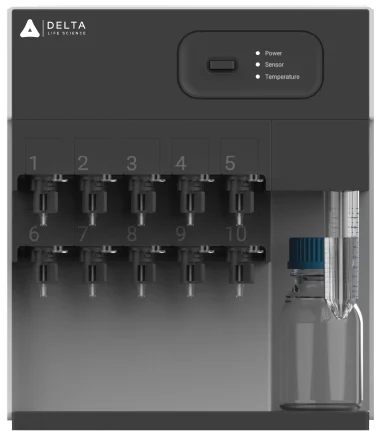
The inQuiQ, biomolecular interaction analysis for binding affinity and kinetics

The inQuiQ brings integrated photonics to biomolecular interaction analysis. By placing most of the optics on the sensor chip, we ensure signal stability while creating a highly sensitive benchtop instrument with a modular upgrade path for higher throughput.
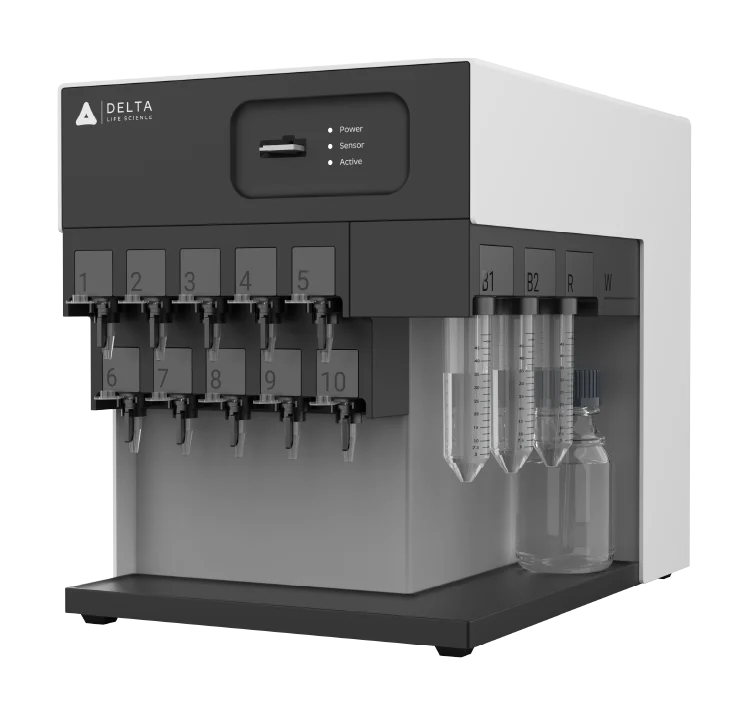
Delta Life Science inQuiQ photonic biosensor instrument
4 channels
16 sensors
30 μL
min. sample volume
10 × 2 mL
Sample capacity
0 MW
no lower MW detection limit

The inQuiQ at a glance

Front view

10 samples
inQuiQ instrument, front view: ten numbered sample positions, four channels and three buffer positions.
4 channels 3 buffers

Model: inQuiQLabel-free biosensor

01Cover the full affinity range

10 pM to 10 mM

02Fits on your bench

30 × 36 × 40 cm, 18 kg

03Give slow binders more time

Injections from 30 μL to 2 mL

04See the small signals

Noise below 0.1 RU RMS

05Run serum and plasma samples

Antifouling hydrogel surface

06Modular upgrade path

Up to 768 samples

01Sample + surface chemistry

Designed around diverse samples and surface chemistries

The inQuiQ measures binding across molecule classes, from small molecules and nucleic acids to antibodies, membrane proteins, and whole particles, with no lower molecular weight limit. Pick the coupling chemistry that fits your ligand, from EDC/NHS amine coupling to biotin, Strep-tag, Protein A/G, lipid layers, and click chemistry.

Sample compatibility

Diverse molecule types across one platform

Molecular scale

100 Da50 kDa150 kDaparticles

Surface chemistry

Choose the coupling strategy for your ligand

Amine coupling

Covalent coupling to carboxyl groups via EDC/NHS

Streptavidin / NeutrAvidin

Capture biotinylated ligands

Protein A and G capture

Immunoglobulin workflows

Streptactin and NTA

Capture Strep-tagged and his-tagged proteins

Lipid layers

Membrane proteins or lipid-interacting molecules

Azide groups

Click-based chemistry

02Chip + flowcell

Addressable flow channels for KD determination

Sample flows across the photonic chip, where molecular binding changes the light beneath the sensor surface. The inQuiQ records these changes in real time as a sensorgram, measuring KD, ka, and kd across multiple targets and controls from one small sample.
  • Four channels with customizable flow paths
  • 4-plex assays with in-flow immobilization, up to 16-plex with a spotter
  • Antifouling hydrogel surface for clean signals in complex media
  • 1 to 100 µL/min flow, up to 300 µL/min for low-viscosity samples
inQuiQ flow cell: four channels plumbed in series, sixteen sensor spots CH-01 IN 1 OUT 1 1 2 3 4 CH-02 IN 2 OUT 2 5 6 7 8 CH-03 IN 3 OUT 3 9 10 11 12 CH-04 IN 4 OUT 4 13 14 15 16

1–16 · sensor spots  ·  pink · binding event

03Detection + performance

The chip: where the magic happens

NES photonic detection

Light travels through microscopic optical waveguides on the chip.
Binding events near the sensing surface change the local refractive index.
The refractive index changes are measured as a real-time sensorgram.
Photonic integrated chip

performance

Baseline noise High-Sensitivity Sensors*
Typically < 0.01 RU RMS
*Coming soon
Baseline noise Sensitivity Sensors
Typically < 0.1 RU RMS
Baseline drift
Typically < 0.3 RU/min
Continuous measurements
Regenerable surface
KD range
10 pM to 10 mM

04Data + software

Intuitive software for multi and single-cycle kinetics

Affinity

Steady-state binding and equilibrium dissociation constant (KD) analysis

Kinetics

ka, kd, and KD interpretation from the sensorgram

Quantification

Concentration and biologically active concentration

Specificity

Screening, epitope binning, thermodynamics, yes/no binding

05inQuiQ specifications

Specifications

01 detection technology

Nanophotonic Evanescent field Sensing

Learn more about NES technology

02Minimum sample volume

from 30 µL sample
and 5 µL injection volume

03Sample handling

10 × 2 mL tubes
1.5 mL generic tubes compatible

04Channels

4 channels, each containing 4 sensors

05Temperature control

16 °C to 40 °C

06Output

Real-time binding response

Sample handling

Channels
44 sensors each
Sample capacity
10 × generic 1.5 or 2 mL tubes
Minimum sample volume
30 µL50 µL recommended
Injection volume range
30 µL to 2 mL
Flow rate range
1 to 100 µL/minup to 300 µL/min for low-viscosity samples

Sensing

Sensor chip
HC1000M, HC30M
Data collection rate
1 Hzsensitivity chips 1, 10, 100 Hzhigh-sensitivity chips
Baseline noise
Typically < 0.1 RU RMSsensitivity chips Typically < 0.01 RU RMSat 1 Hz, high-sensitivity chips*
*Coming soon
Baseline drift
< 0.3 RU/mintypically

Measurement range

Association rate constant, ka
101 to 107 M-1s-1
Dissociation rate constant, kd
1 to 10-6 s-1
Affinity, KD
10 pM to 10 mM
Sample refractive index range
Unlimited

Buffers and physical

Running buffer capacity
2 × 50 mL
Regeneration buffer capacity
1 × 50 mL
Temperature control
16 to 40 °Cmax 4 °C below ambient
Dimensions, W × H × D
30 × 36 × 40 cm
Net weight
18 kg

06Plan a demo

See how the inQuiQ fits your workflow

Tell us your panel, your formats, and the binding questions you need answered. We will show you the inQuiQ on an assay close to yours.

Ready to see the inQuiQ in action?

Questions researchers ask

The inQuiQ's NES technology and surface plasmon resonance work on the same principle: binding at a sensor surface changes the refractive index inside an evanescent field. NES puts that optical path onto a photonic chip, which brings higher sensitivity at a lower instrument cost. BLI dips a sensor tip into the sample, great for crude media, but less sensitive with off-rates. ITC is a different measurement: solution-phase thermodynamics, no immobilization, no rate constants.

Nanophotonic evanescent field sensing (NES) is the detection method behind the inQuiQ. Light circulates in optical ring resonators on a photonic integrated circuit, and its evanescent field reaches just past the sensor surface. Binding shifts the resonance. Printing the optics onto a chip is what makes 16 stable sensors and lower instrument cost possible with the highest sensitivity.

One method covers most binding questions: KD determination, multi cycle and single cycle kinetics, steady-state affinity, competitive and inhibition assays, epitope binning and cross-blocking, off-rate ranking, dose-response with IC50 and EC50, ternary complex and cooperativity assays, active concentration and titer, anti-drug antibody kinetics in matrix, and thermodynamic studies across a temperature series.

Older SPR systems reach a point where the service contract ends, spare parts get scarce, and the control software no longer fits current IT policy. The data may still be fine, but the risk sits in uptime. And what does an SPR instrument cost to replace? The inQuiQ returns the same kinetic characterization parameters, KD, kon, and koff, on a supported instrument, with high sensitivity and a lower cost of ownership.

For binding questions, yes. ELISA reports an endpoint after wash and detection steps, so it shows how much bound, not how fast or how tightly. The inQuiQ follows association and dissociation in real time on unmodified molecules and returns KD, kon, and koff from one sample, with no secondary antibody and no enzyme label.