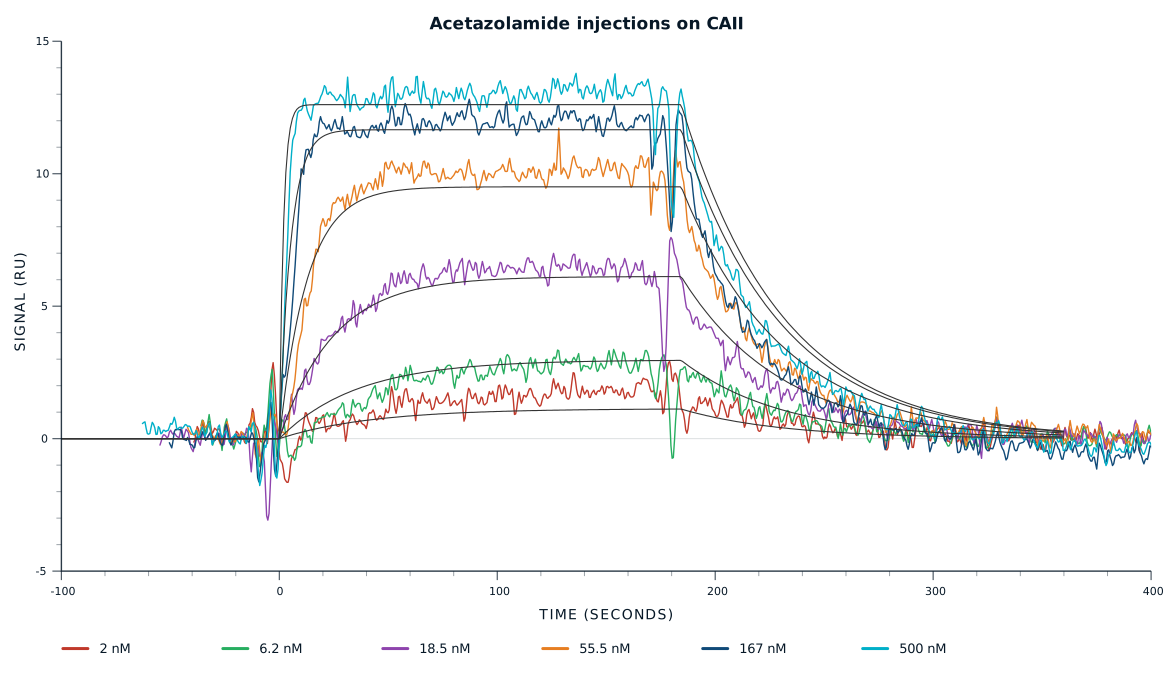
Aptamer screening and characterization
Rank the sequences that come out of aptamer selection.
Measure affinity and off-rate for each candidate against the same target.
aptamer KD

Label-free interaction analysis measures binding between unmodified molecules in real time. For nucleic acids it returns affinity (KD), association and dissociation rates, and specificity against mismatch and scrambled controls, with no fluorophore or reporter on the sequence.
Rank the sequences that come out of aptamer selection.
Measure affinity and off-rate for each candidate against the same target.
Work with phosphorothioate, LNA, and 2'-modified chemistries.
Compare binding across backbone modifications on one surface.
Run an RNA binding protein assay or a DNA binding protein assay against the same immobilized site.
Titrate the protein against an immobilized sequence to get KD.
Follow a duplex forming as it happens.
Measure how fast a complementary strand anneals and comes apart.
Test the target sequence against its own controls.
Spot mismatch, scrambled, and off-target sequences alongside the target.
Discuss your assay with one of our application specialists.

Four independently addressable channels with four sensors each, all reading one sample in series.
The full injection is recorded, so fast-dissociating duplexes and aptamers are read while still bound.
Capture and covalent coupling are both available, so the oligonucleotide attaches at the end that takes no part in binding.
Immobilize the target next to its mismatch, scrambled, and off-target controls, then inject once.
Every measurement follows the same steps, whatever the sequence. One partner is held on the sensor, the other flows past, and the response is recorded through the whole injection rather than at the end.
The oligonucleotide is attached to the sensor surface first.
For nucleic acid binding kinetics analysis, end capture or covalent coupling leaves the binding region free, whether the sequence is an aptamer, an ASO, or a CRISPR guide. Density is kept low enough that the measured rates reflect binding rather than transport to the surface.
Unused activated sites are switched off before the first sample arrives.
Otherwise the surface keeps reacting with whatever passes over it, and non-specific binding appears in the sensorgram as signal unrelated to the sequence being measured.
The binding partner flows across the surface and the response climbs.
Whether the injected partner is a complementary strand, a DNA-binding protein, or an aptamer target, the association phase gives the on-rate, ka, for hybridization or for protein binding.
Buffer replaces the sample and the response falls as the duplex or complex comes apart.
The dissociation phase gives kd, and 1/kd gives complex lifetime. A concentration series gives ka, kd, and KD. Where dissociation is fast, plateau responses give steady-state aptamer affinity.
A short denaturing wash strips the bound partner and returns the sensor to baseline.
The attached sequence stays in place, so every SELEX candidate or backbone variant meets the same surface across the screen.
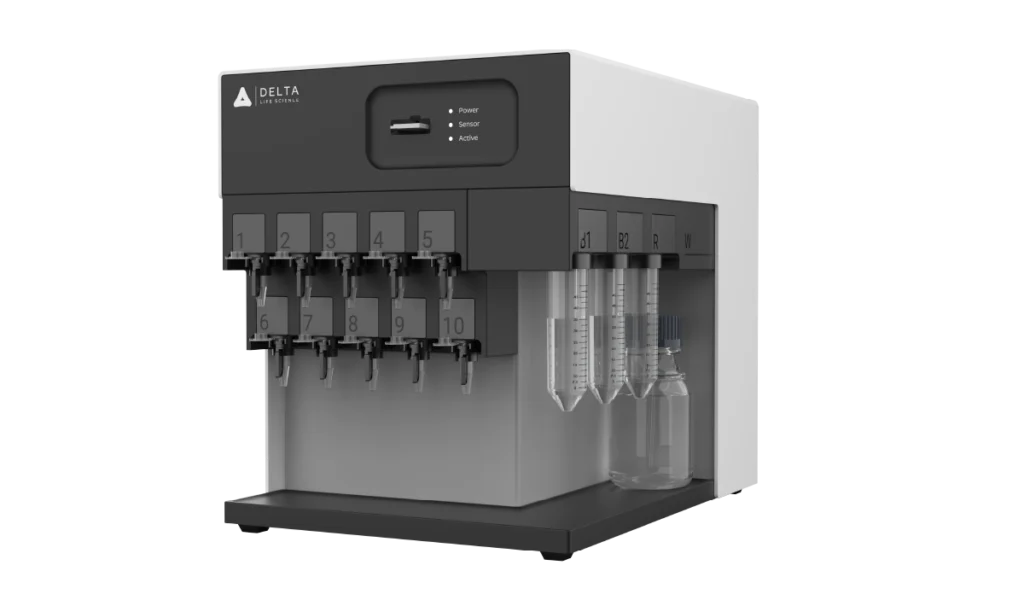
Six capabilities, one modular benchtop instrument, in a label-free workflow.
Four channels with in-flow immobilization, or sixteen sensors with a spotter, compare candidates and controls from one injected sample.
Baseline noise stays low enough that a short-lived complex is still readable.
One binding affinity range covers a low-affinity nucleic acid hybridization assay and high-affinity aptamers, with steady-state fitting when dissociation is too fast for kinetics.
Capture or covalent coupling attaches a modified backbone at the end that takes no part in binding.
Flow rate sets how long the sample meets the surface, which matters when the analyte is dilute. 1 to 100 µL/min, up to 300 µL/min for low-viscosity samples.
Simply add an autosampler, and run a long sequence or condition series unattended.
Immobilize the aptamer through an end tag, then inject the target across a concentration series. The association phase gives kon, the dissociation phase gives koff, and the two together give KD. On the inQuiQ affinity runs from 10 pM to 10 mM, and in aptamer screening every candidate from one selection round is measured on the same surface.
Attach the DNA sequence to the sensor and inject the protein as a dilution series. Binding is recorded in real time, so you get association and dissociation rates as well as KD. Neither partner carries a fluorophore, so the measured affinity is not shifted by a reporter group.
Often, yes. The response is recorded continuously through the injection, so a complex that lasts seconds is visible while it is bound rather than after it has gone. Where dissociation is too fast to fit kinetics, plateau responses across a concentration series give a steady-state affinity instead. An oligonucleotide melting temperature describes the equilibrium a duplex settles into, and the sensorgram describes how fast it gets there and how long it lasts.
Either capture the sequence through an end tag or couple it to the surface chemistry directly. Phosphorothioate, LNA, and 2'-modified backbones are attached the same way. Attach the end that takes no part in binding, so the site stays free and the measured rates stay meaningful, and oligonucleotide characterization stays comparable across the whole set.
Spot the target sequence next to mismatch, scrambled, and off-target controls on one chip, using up to sixteen sensors with a spotter. One sample is then injected and flows through the channels in series, so every control meets the same material under the same conditions.