
On this page
Questions about your own assay?
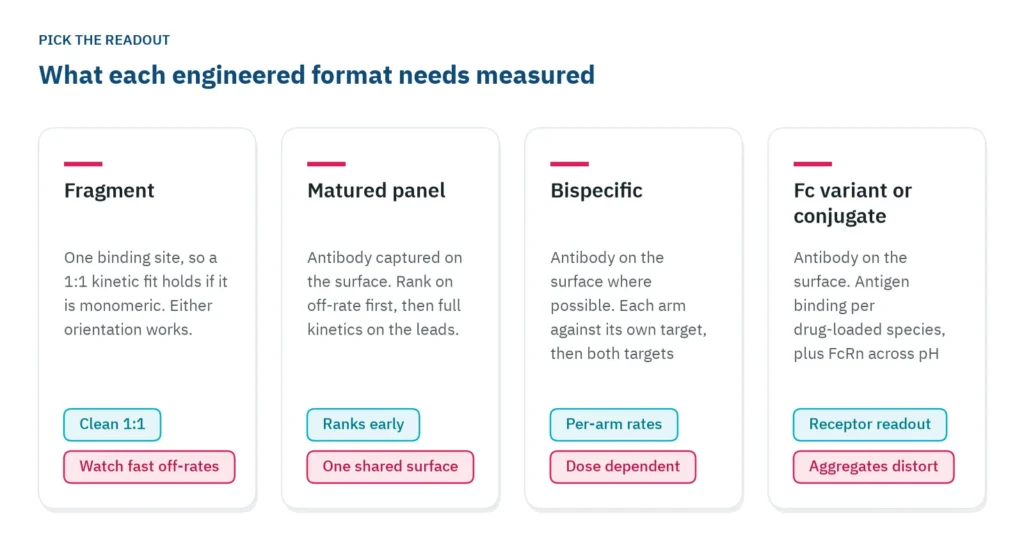
Ask a specialistAntibody engineering changes one part of a molecule, and the binding data has to speak to that part. Pick the readout from the change: one site for a fragment, each arm plus the complex for a bispecific, receptor binding across a pH range for an Fc variant. Then put the multivalent partner on the surface.
Antibody engineering changes one part, so measure that part
An engineered antibody is a deliberate change to one part of an immunoglobulin: the variable domains for what it binds, the Fc for how long it circulates and which immune receptors it engages, the architecture for valency, size or a conjugated payload [1]. Antibody engineering projects stall at review when the binding data does not speak to that change.
Decide which number has to move before you book instrument time.
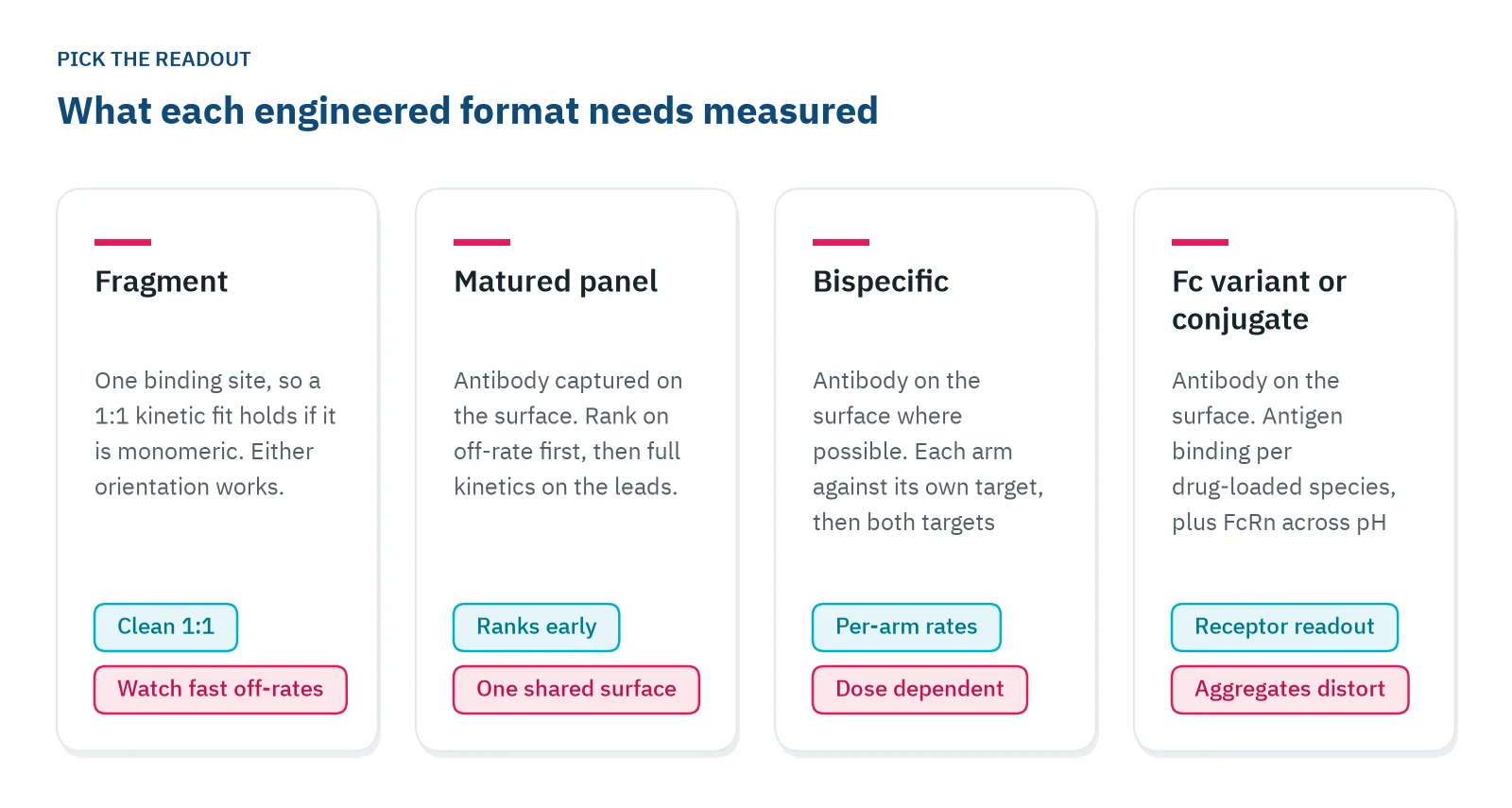
Fragments are the simplest case. A Fab, scFv or single-domain antibody carries one binding site, so a 1:1 model is defensible, provided it is monomeric: check scFv by size exclusion, since dimers bind like a bivalent analyte. The work then runs like any small single-domain binder. Whether you report a kinetic fit or a steady-state affinity follows from the rates you see, not from the format.
Avidity or affinity: which does your number describe?
If a two-armed construct flows over a surface carrying its target, each molecule can hold two sites at once, and your fitted number is avidity. Release at one site does not free the molecule, so the complex looks tighter and longer-lived than one binding site is [2].
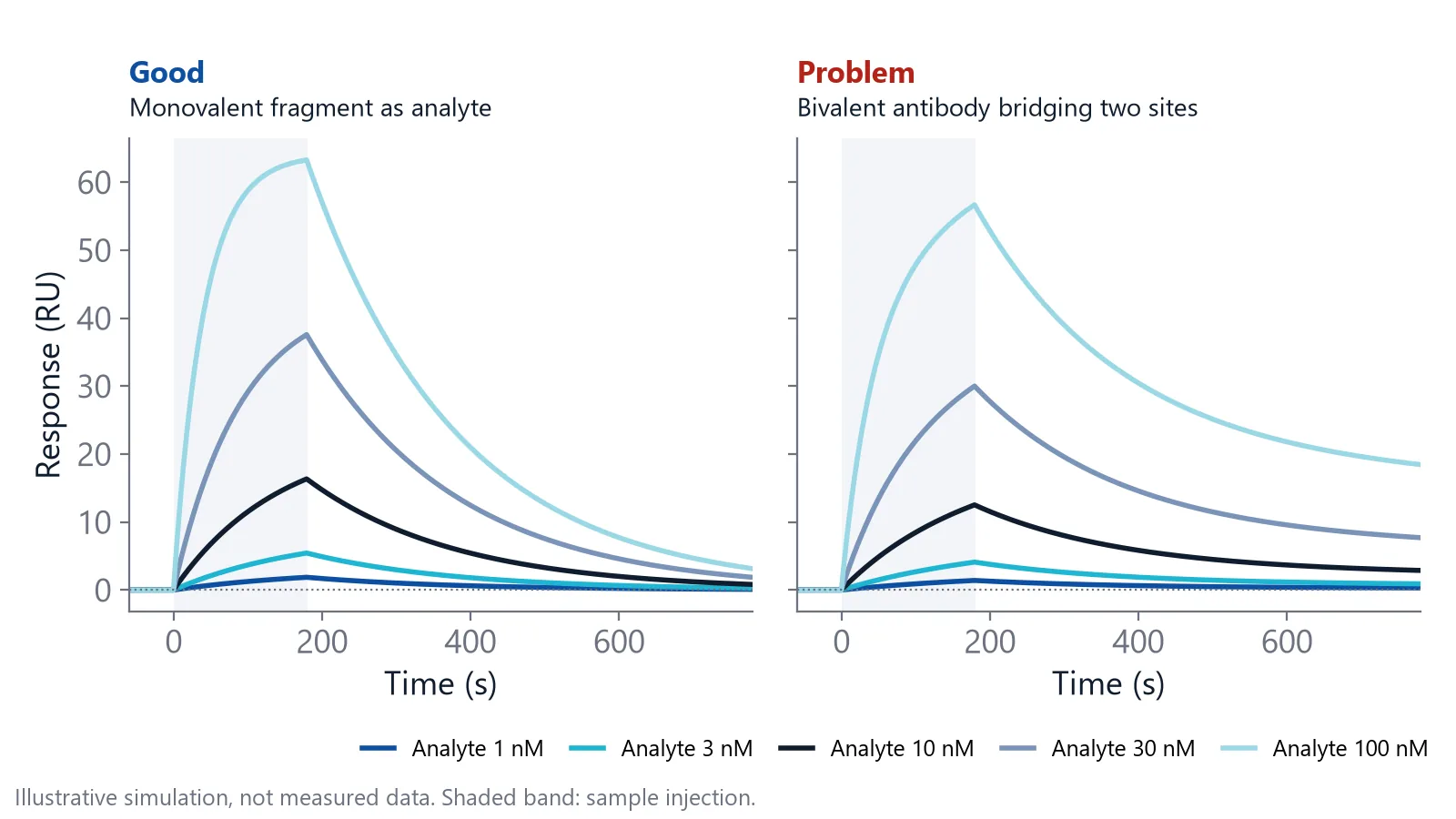
Two fixes exist. Lower the ligand density until the molecules on the surface are too far apart to be bridged, which costs signal and limits how far you can go. Or swap the roles: immobilize the bivalent antibody and flow the target over it. The second is the more reliable of the two [3]. A monovalent analyte on a bivalent surface does not create the problem, because the two sites act independently [2].
The reversed orientation needs a chemistry that holds the antibody by its Fc and leaves the arms free. Delta supplies sensor chips with Protein A and Protein G surfaces for that capture.
A bivalent-analyte model shows the behavior is there, but it cannot return valid constants for both sites [2], so do not report it as an affinity. Surface plasmon resonance (SPR), biolayer interferometry (BLI) and Nanophotonic Evanescent field Sensing (NES) all read mass bound at a surface, so the trap is the same on each.
Bispecifics need three measurements, not one
Linking two specificities in one molecule creates a dependency between them: binding can be sequential or simultaneous, which is why a bispecific does not behave like a mixture of its parent antibodies [4]. Measure each arm against its own target, then both targets together.
Emicizumab shows how far two arms can diverge. It associates about five times faster with factor X than with factor IX and stays bound roughly twenty times longer, a hundredfold difference in affinity: a KD of 56 nM against 5.5 µM [5].
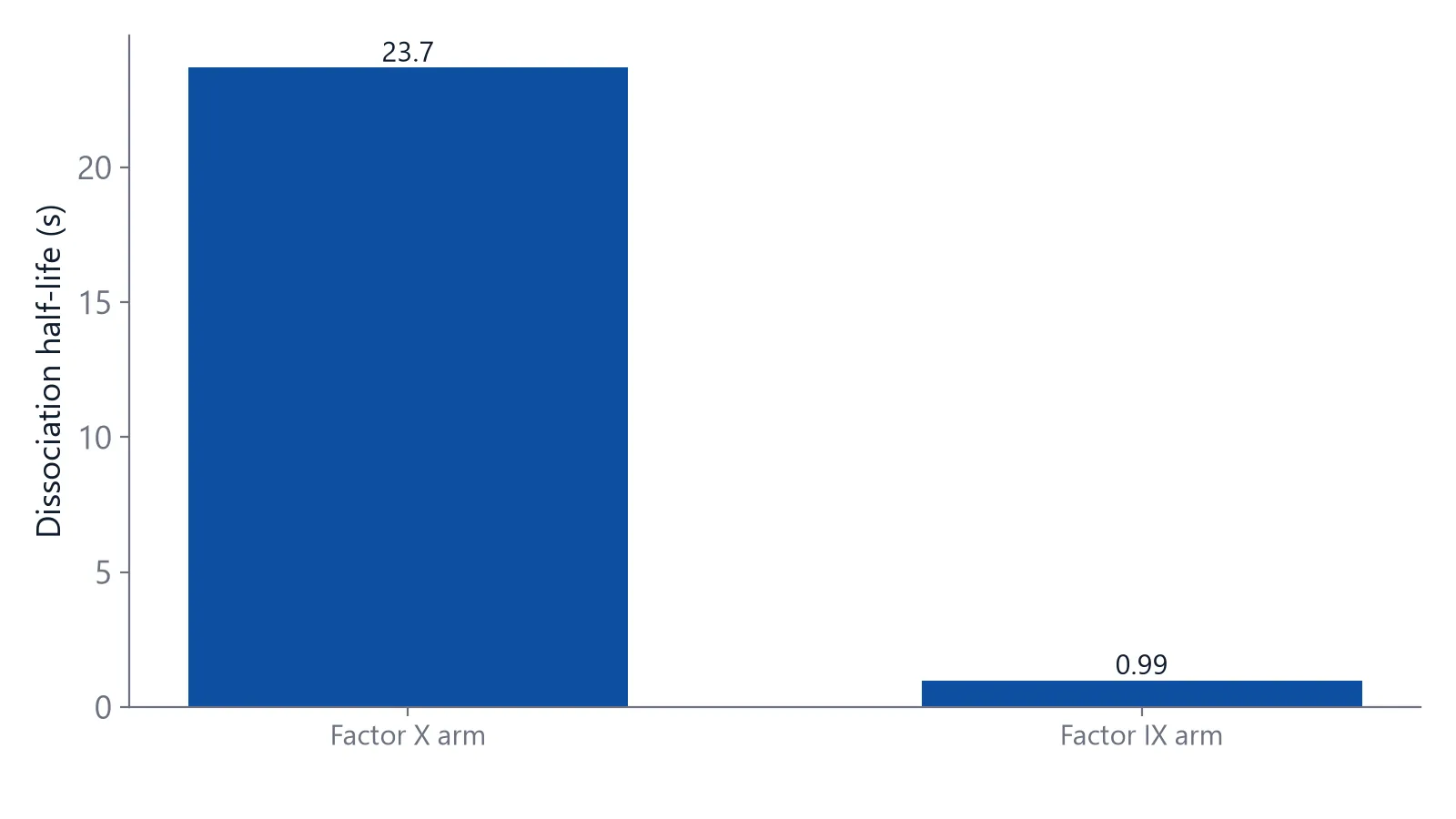
With both targets held at a fixed spacing on a DNA nanostructure, the picture changed again. Dissociation from factor IX turned biphasic, picking up a slow component that matched factor X, while the factor X kinetics stayed as they were [5]. How much two-target complex formed depended on the antibody concentration during association: at high concentrations two antibodies occupied the target pair separately, which the authors compare to the high-dose hook effect of immunoassays [5]. Inject a concentration series, or you report whichever mode your single dose happened to favor.
So you need surfaces: target A alone, target B alone, both together, and a reference. On a randomly coated surface the amount of two-target complex depends on how densely and evenly both targets are coated, so report the ratio and the density. On inQuiQ one injection flows through all four channels in series, each carrying its own ligand, with one as the reference, so target A, target B and the reference see the same sample.
Fc variants and conjugates: measure the receptor side
Change the Fc, or hang a cytotoxic payload on it to build an antibody-drug conjugate (ADC), and the antigen may still bind perfectly while the property you were after moves somewhere else. FcRn binding is the half-life readout, and it is pH dependent by design: each IgG can engage two FcRn molecules, one at the CH2-CH3 junction of each heavy chain [3] [6], so the data carries affinity and avidity together and orientation matters here too. Report FcRn across a pH range rather than as one value, associating near pH 6 and following dissociation at both pH 6 and neutral pH [7].
Process and stress attributes can move Fc receptor binding as much as the engineering does, and each hits its own receptors [7].
| Sample attribute | Binding versus reference | Receptors affected |
|---|---|---|
| 70% afucosylated | 158 to 186% | FcγRIIIa and FcγRIIIb only |
| Fully deglycosylated | 15% or less | All Fcγ receptors; FcRn still binds but leaves faster at neutral pH |
| Asparagine deamidation | 50 to 80% | Low-affinity Fcγ receptors; FcγRI and FcRn unchanged |
| Dimers and oligomers | 400 to 800% | Low-affinity Fcγ receptors, as an artifact; FcγRI and FcRn shift too |
The last row is the one that catches people. Purified covalent dimers and oligomers raised apparent affinity six- to eightfold on FcγRI, an avidity effect rather than a real change in affinity [7]. Run size exclusion before you run the sensor.
Conjugates add two questions. Cysteine conjugation leaves a mixture of species carrying two, four, six and eight drugs, and the stated ratio is a weighted average; hydrophobic payloads at high loading bound less target antigen than the unconjugated antibody, while hydrophilic payloads did not [8]. Loading moves the Fc side as well: the most heavily loaded species of one conjugate bound FcRn more strongly than the unconjugated antibody [9]. Those species also aggregated more, so check them by size exclusion first [9]. Measure the separated species, not only the mixture.
How do you screen engineered variants at scale?
Capture every variant on the same surface at a similar density, rank them on off-rate, and spend purified protein and full kinetics only on the leads. Off-rate does not depend on analyte concentration, so unpurified samples still rank. A KD does not tolerate them, because it needs a known active concentration.
Off-rate is often the parameter that tracks function. Across affinity-matured anti-ricin clones, KD correlated only weakly with neutralization potency (r = 0.55) while off-rate correlated well (r = 0.84) [10].
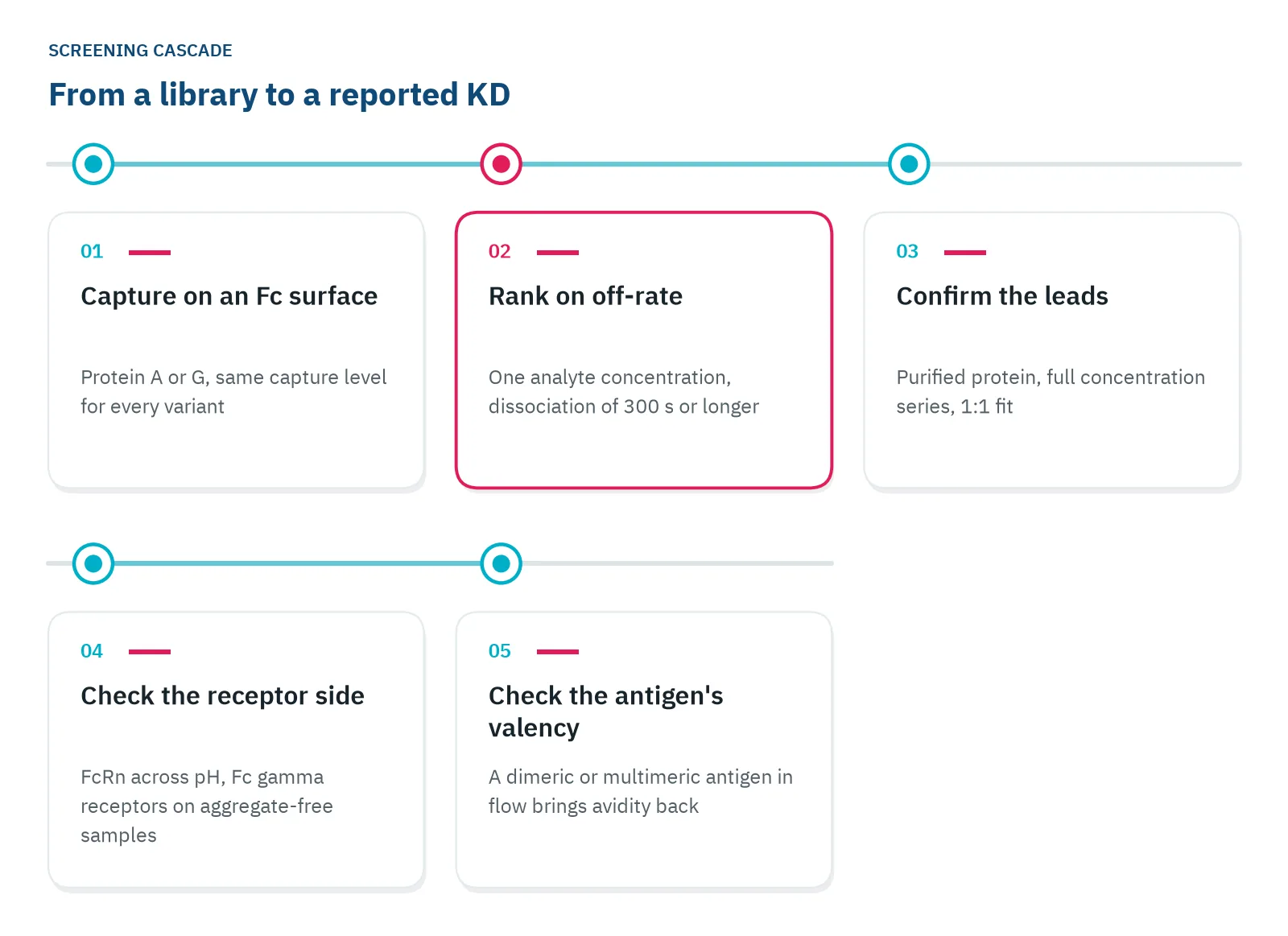
One ranking experiment ran 88 antibodies as B-cell culture supernatant, because purifying them all before any neutralization or sequence data existed was not worth the effort [11]. For the ranking to hold, immobilize every candidate in the same orientation at a similar density, which means the sample concentrations need to be similar [11]. An endpoint assay cannot do this: ELISA reads equilibrium, so fast-dissociating candidates wash away, while a real-time trace separates association from dissociation and still finds them [2]. The same reasoning drives antibody clone screening.
Screening engineered variants on inQuiQ768
When the panel runs to hundreds of variants, the limit is how many samples you can start and walk away from. inQuiQ768, the high-throughput version of inQuiQ, ranks antibody clones by off-rate directly from crude supernatant filtered through 0.22 µm. It takes up to 768 samples at a time. Start a saved sequence and let it run unattended, overnight if you like.
Choosing your setup
Three entries belong in the results table of every antibody engineering project.
- Orientation and ligand density next to every number
- The capture level of each variant in a panel
- A reversed-orientation run for each lead before you quote its KD
Nobody reading the table later can tell avidity from affinity without them. The antibody affinity and kinetics application page lists the assay types these setups cover.
Questions researchers ask
How many analyte concentrations does a kinetic fit need?
Five or six in a two-fold or three-fold series, spanning roughly a tenth of the expected KD to ten times it, with one concentration repeated to show the surface has not changed. Fewer points can still fit, but the fit no longer tests whether the model is right.
Should I capture the antibodies or couple them to the surface for a variant panel?
Capture suits a panel: one Protein A or G surface serves every variant, and each cycle starts with fresh antibody. Match the capture level across variants, and check that different subclasses capture comparably on Protein A or G. Covalent coupling gives a steadier baseline for the few leads you run in full, but each variant then needs its own surface.
What should I do when an engineered variant barely dissociates?
Extend the dissociation rather than fitting a flat line. Watch a single injection for several hours, and check a buffer-only cycle over the same period so you can tell real dissociation from surface decay. If the signal stays flat, report the off-rate as slower than your resolution.
Is ELISA still useful during an antibody engineering campaign?
Yes, for the questions it answers well: expression titer, a yes or no specificity check against related antigens, and counter-screening against the tag or the fusion partner. It is cheap per sample and runs in any lab. Use it to triage, then measure rates on the survivors.
References
- Goulet DR, Atkins WM. Considerations for the Design of Antibody-Based Therapeutics. J Pharm Sci. 2020. doi:10.1016/j.xphs.2019.05.031
- Real-Time Analysis of Biomolecular Interactions. Springer Japan. 2000. doi:10.1007/978-4-431-66970-8
- Apiyo DO. Biolayer Interferometry (Octet) for Label-free Biomolecular Interaction Sensing. Handbook of Surface Plasmon Resonance. 2017. doi:10.1039/9781788010283-00356
- Labrijn AF, Janmaat ML, Reichert JM et al.. Bispecific antibodies: a mechanistic review of the pipeline. Nat Rev Drug Discov. 2019. doi:10.1038/s41573-019-0028-1
- Mak S, Marszal A, Matscheko N et al.. Kinetic analysis of ternary and binary binding modes of the bispecific antibody emicizumab. MAbs. 2023. doi:10.1080/19420862.2022.2149053
- Reusch J, Andersen JT, Rant U et al.. Insight into the avidity-affinity relationship of the bivalent, pH-dependent interaction between IgG and FcRn. MAbs. 2024. doi:10.1080/19420862.2024.2361585
- Geuijen KPM, Oppers-Tiemissen C, Egging DF et al.. Rapid screening of IgG quality attributes - effects on Fc receptor binding. FEBS Open Bio. 2017. doi:10.1002/2211-5463.12283
- Nadkarni DV, Lee J, Jiang Q et al.. Impact of Drug Conjugation and Loading on Target Antigen Binding and Cytotoxicity in Cysteine Antibody-Drug Conjugates. Mol Pharm. 2021. doi:10.1021/acs.molpharmaceut.0c00873
- Brachet G, Respaud R, Arnoult C et al.. Increment in Drug Loading on an Antibody-Drug Conjugate Increases Its Binding to the Human Neonatal Fc Receptor in Vitro. Mol Pharm. 2016. doi:10.1021/acs.molpharmaceut.6b00082
- Rosenfeld R, Alcalay R, Mechaly A et al.. Improved antibody-based ricin neutralization by affinity maturation is correlated with slower off-rate values. Protein Eng Des Sel. 2017. doi:10.1093/protein/gzx028
- Wagner K. Combined Antibody Characterization: High-throughput Ranking, Binning, and Mapping. Handbook of Surface Plasmon Resonance. 2017. doi:10.1039/9781788010283-00295
Keep reading
 How to measure antibody binding kinetics: setup, rates and reportingA practical guide to antibody binding kinetics: which partner goes on the surface, how to set concentrations and times from the expected rates, how to check the fit and what to report.Applications
 Matrix effects in binding assays: how serum changes your signalSerum can raise, lower or blur the signal of a binding assay. Learn where matrix effects come from, how to test for them, and how to reduce them in ELISA and label-free assays.Applications
 Tetraspanins CD9, CD63 and CD81: EV markers and binding targetsTetraspanins CD9, CD63 and CD81 are the standard handles for detecting and capturing extracellular vesicles. This article explains what they are, why they are not on every vesicle, and how to set up binding measurements around them.