
Switching from ELISA
For researchers who answer binding questions with ELISA today. What real-time, label-free measurement adds, what changes in your workflow, and when ELISA is still the right tool.
ELISA tells you whether something binds. A real-time binding assay also tells you how fast it binds and how long it stays bound, which matters when you rank antibody clones or compare candidates with similar endpoint signals.
These articles cover what ELISA can tell you about binding affinity, alternatives to ELISA for binding studies and moving antibody clone screening from ELISA to label-free.
3 articles in Switching from ELISA
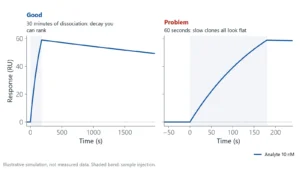 Antibody clone screening: from ELISA hits to off-rate rankingAn ELISA tells you which clones bind, not which ones hold on. How to rank hybridoma and library clones by off-rate straight from supernatant, and when ELISA is still the right first step.
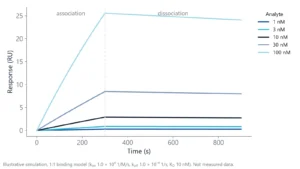 An alternative to ELISA when you need affinity and kineticsELISA shows what stayed bound after the washes. If you need affinity and binding rates, here is what to use instead, what changes in your workflow, and when the plate is still the better tool.
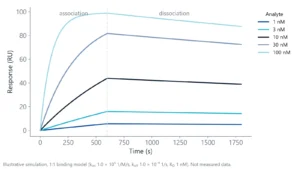 ELISA binding affinity: what it can tell you and what it missesELISA can estimate a KD, but the format decides what that number means. Four formats, three biases, the checks to run and when ELISA is still the right tool.
Measured on inQuiQ
Application notes with real data from Delta's own lab.
WhitepaperReal-time, label-free NES analysis characterized PD-1/PD-L1 binding, delivering reproducible kinetic measurements with a KD of 37.7 nM.PD-1/PD-L1 InteractionWhitepaperLabel-free analysis quantified BMS-1166 inhibition of PD-1/PD-L1 binding, demonstrating dose-dependent inhibition with an IC₅₀ of 8.2 nM.PD-1/PD-L1 Inhibition with BMS-1166WhitepaperKinetic analysis of 250 Da small molecule interactions with Carbonic Anhydrase II using label-free sensing.Small Molecule Interactions
Have a question about this topic?
Tell an application specialist about your molecules and what you need to measure. You will get a straight answer on the setup that fits.